What Are Incoterms for China Sourcing?
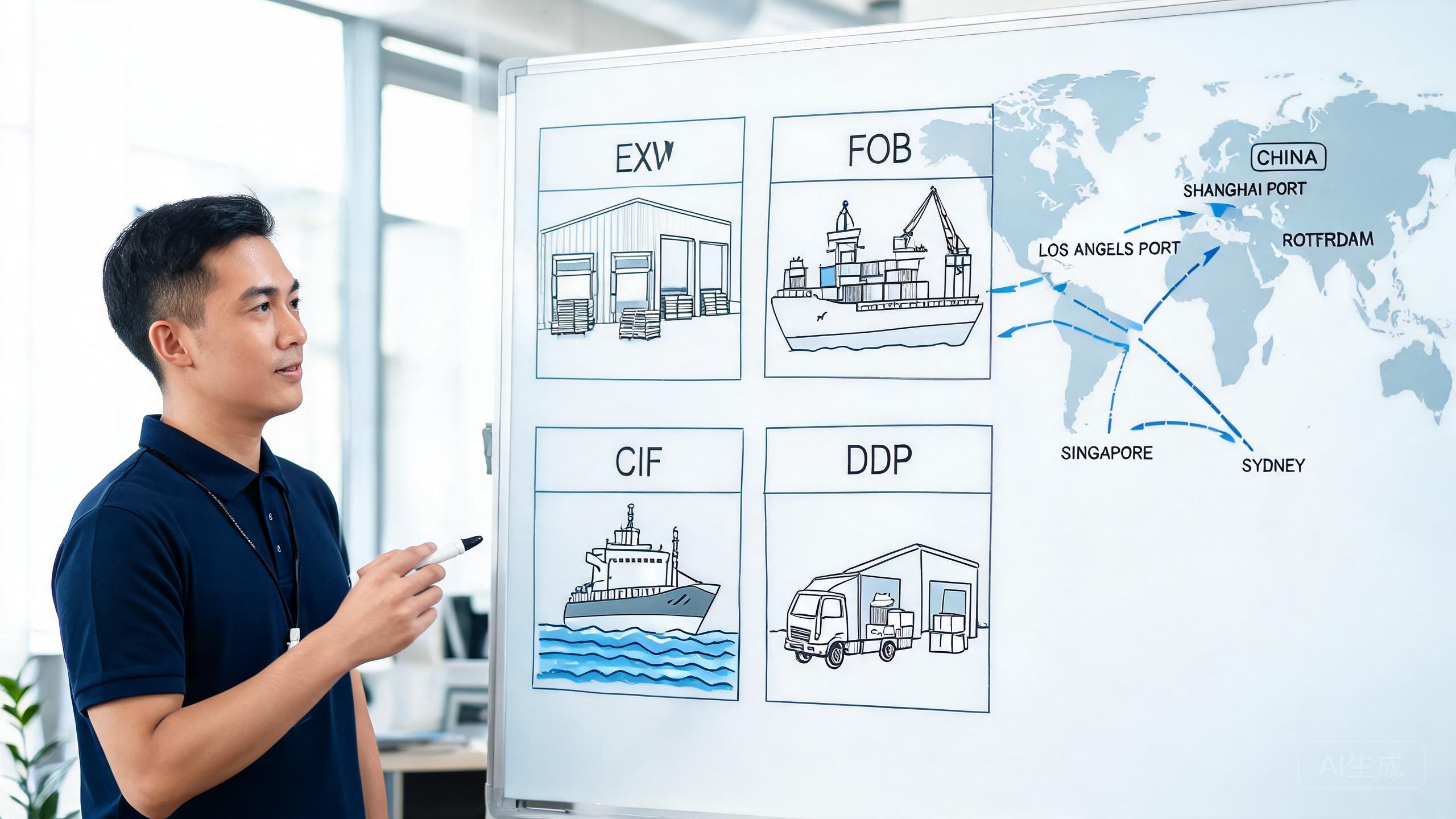
Incoterms (published by the ICC, current version Incoterms 2020) are 11 standard trade terms that define who pays for freight, who clears customs, and where risk transfers between buyer and seller. When sourcing from China, four terms cover 95% of shipments: EXW, FOB, CIF, and DDP. Choosing the wrong one can cost you 10%–30% in hidden freight, surprise duty bills, or lost cargo. The golden rule: compare total landed cost, not the unit price on the PI.
Core Incoterms Comparison (China Sourcing)
| Incoterm | Who Pays Freight | Export Clearance | Import Clearance | Risk Transfer | Best For |
|---|---|---|---|---|---|
| EXW (Ex Works) | Buyer | Buyer | Buyer | At factory door | Large volume, own broker |
| FOB (Free On Board) | Buyer | Seller | Buyer | On board vessel | Experienced sea importers |
| CIF (Cost Ins. Freight) | Seller | Seller | Buyer | On board vessel | Avoid — supplier controls freight |
| DDP (Delivered Duty Paid) | Seller | Seller | Seller | At buyer's door | Beginners, small orders |
| FCA (Free Carrier) | Buyer | Seller | Buyer | To named carrier | Air freight, LCL |
EXW, FOB, CIF, DDP — What Each Really Means
- EXW (Ex Works) — the seller makes goods available at their factory; you arrange and pay for everything: China inland trucking, export clearance, ocean freight, insurance, import duty, and last-mile. Lowest unit price, but only viable if you have a China trucking broker and destination customs broker.
- FOB (Free On Board) — the seller delivers goods onto the vessel at the named port of shipment (e.g., FOB Ningbo). You pay for ocean freight, insurance, import clearance, and duty. Most common for China sea FCL because the seller handles export and you control the freight line.
- CIF (Cost, Insurance, Freight) — the seller pays freight and insurance to the destination port. Risk still transfers when goods go on board (same as FOB). Avoid: the seller picks the line and may use slow steamships or inflate freight by 20%–40%.
- DDP (Delivered Duty Paid) — the seller handles everything to your door: export, freight, insurance, import duty, and last-mile. Simplest for beginners — one all-in price, zero customs admin.
Cost Comparison: Same Order, Four Incoterms
Real 1,000-unit order at $5.00 EXW from a Yiwu factory, 4 cbm, sea to Los Angeles. Below is how the same cargo's per-unit landed cost breaks down under each Incoterm — line by line, no rounded "round number" math.
| Cost Line Item | EXW | FOB (Ningbo) | CIF (LA port) | DDP (LA door) |
|---|---|---|---|---|
| Goods EXW (factory) | $5.00 | $5.00 | $5.00 | $5.00 |
| Yiwu→Ningbo trucking (~$110/4cbm) | $0.11 | — | — | — |
| China export clearance + docs (~$95) | $0.10 | — | — | — |
| THC + ISPS + doc fee at Ningbo (~$140/20ft shared) | $0.07 | — | — | — |
| Ocean freight Ningbo→LA (FCL share, ~$1,500/20ft) | $0.15 | $0.15 | — | — |
| Insurance (110% CIF value × 0.35%) | $0.02 | $0.02 | — | — |
| Supplier's CIF markup (typical 18%) | — | — | $0.05 | — |
| US customs entry (~$175 + bond) | $0.18 | $0.18 | $0.18 | — |
| ISF (10+2) filing (~$35) | $0.04 | $0.04 | $0.04 | — |
| HTS duty + Section 301 (avg ~12.5%) | $0.69 | $0.69 | $0.69 | — |
| MPF + HMF (~0.345% + 0.125%) | $0.03 | $0.03 | $0.03 | — |
| LA port drayage + last-mile (~$260) | $0.26 | $0.26 | $0.26 | — |
| Forwarder/agent all-in margin | $0.40 | $0.30 | $0.00 | $0.85 |
| Landed unit cost | ~$7.05 | ~$6.85 | ~$6.95 | ~$6.85 |
Three takeaways from the line items:
- EXW is rarely cheapest once you add your own China-side trucking + broker fees. A $5.00 EXW product can land at $7.05 vs. $6.85 FOB — the savings evaporate because small buyers can't negotiate Ningbo trucking or export docs as cheaply as the supplier can bundle them.
- CIF often costs more than FOB for the same door. The supplier's 15%–25% markup on freight + the same US-side customs work means you pay ~$0.10/unit extra for less control. Plus you cannot choose the carrier or transit time.
- DDP priced honestly is competitive with FOB when the forwarder is your own (not the supplier's buddy). The "DDP premium" myth comes from comparing apples (supplier DDP with kickback) to oranges (your FOB).
For a $5,000 first order, FOB saves ~$200 vs. CIF and ~$700 vs. naive EXW. For repeat $50k+ FCL orders where you have a destination broker, FOB regularly saves $4,000–$8,000 per container versus DDP once your volume justifies a contract freight rate.
Which Incoterm Should You Choose?
- Beginners / small orders (<$10k) → DDP. One price, door-to-door, no customs paperwork. Use a reputable forwarder, not the cheapest Alibaba DDP quote.
- Experienced importers with a destination broker → FOB. You control the ocean line, consolidate cargo, and save 5%–15% vs DDP. Get an all-in FOB quote including THC and docs.
- Large volume (FCL, $50k+) → EXW. Lowest unit price; you run your own China trucking and destination clearance. Only if you have reliable brokers on both ends.
- Air freight / LCL → FCA. Supplier delivers to the airline or consolidator's warehouse; you control the air or LCL rate.
How Suppliers Game CIF (and FOB)
- CIF freight inflation — supplier quotes "free freight" but marks up the ocean rate by 20%–40%, or uses a slow 35-day line instead of a 22-day direct service.
- CIF insurance gaps — supplier buys the cheapest 110% cargo cover with high deductibles; you find out after a claim is denied.
- FOB hidden local charges — THC (terminal handling), documentation fee, customs declaration, and EIR fee can add $100–$300 per FCL beyond the FOB price. Demand an all-in FOB breakdown.
Protection: always request an itemized quote and compare the freight line against independent rates from 2–3 forwarders.
How Yeatru Handles Incoterms
Yeatru quotes transparently across incoterms so you can choose:
- FOB quotes include all China-side local charges (THC, docs, export declaration) — no surprises.
- DDP quotes are all-in door-to-door with duty prepaid and tracked — ideal for Amazon FBA and first-time importers.
- FCA for air and LCL — you control the freight line while we handle export clearance.
- We never push CIF — we'd rather show you the real freight rate and let you decide.
FCA, CPT, CIP: When They Matter (and Why Most Buyers Skip Them)
Most China importers live in FOB/EXW/DDP land and never touch FCA, CPT, or CIP. But for air freight, LCL consolidation, and multimodal shipments, these three terms are the right tool — and using FOB/EXW instead creates real problems.
- FCA (Free Carrier) — the supplier delivers goods, cleared for export, to a named carrier (e.g., "FCA Hong Kong Air Cargo Terminal"). This is the air-freight equivalent of FOB. Use it when shipping by air (FedEx/DHL are not "vessels," so FOB technically doesn't apply) or with LCL consolidators. Pro tip: if your supplier insists on FOB for an air shipment, switch to FCA — under FOB, risk doesn't legally transfer to you until goods are "on board the vessel," which never happens for air freight. That ambiguity is a $0 cargo claim waiting to happen.
- CPT (Carriage Paid To) — the supplier pays freight to a named destination (e.g., "CPT Chicago O'Hare"), but risk transfers when goods are handed to the first carrier (not at destination). Use it when you want the supplier to handle freight but you'll arrange your own insurance — typically for established multimodal routes.
- CIP (Carriage and Insurance Paid To) — like CPT but the supplier also buys insurance (minimum 110% of CIP value, Institute Cargo Clauses A). Use CIP instead of CIF when the journey isn't purely sea (e.g., sea-air combo Yiwu→Shenzhen→HK air→EU). Common mistake: buyers accept supplier "CIP" quotes with Institute Cargo Clauses C (named perils only) instead of A (all-risks). Demand Clauses A — the premium difference is $5–$15 per $10,000 of cargo, but the claim payout difference can be total vs. zero.
For most sea FCL importers, FOB covers 90% of cases and DDP covers the other 10%. Reach for FCA/CPT/CIP only when the cargo moves by air, LCL, or multimodal — using the wrong Incoterm there can void your insurance claim or leave risk on the supplier's books for the whole journey.
Frequently Asked Questions
1. What is the difference between EXW, FOB, CIF, and DDP?
EXW: buyer picks up at the factory and handles all logistics, export, import, and duty. FOB: seller delivers to the ship; buyer pays ocean freight, insurance, import, and duty. CIF: seller pays freight and insurance to the destination port; buyer clears import and pays duty. DDP: seller handles everything to the buyer's door, including import duty. Risk transfers at factory door (EXW), on board (FOB/CIF), or buyer's door (DDP).
2. Which incoterm is best for beginners sourcing from China?
DDP (Delivered Duty Paid). The supplier or forwarder handles export clearance, freight, insurance, import duty, and last-mile to your door. You get one all-in price and zero customs admin. Once you have volume and a destination broker, switch to FOB to save 5%–15%.
3. Why should I avoid CIF when sourcing from China?
Under CIF the supplier selects the shipping line and pays freight, so they often use the slowest carrier (adding 5–10 transit days) and inflate freight by 20%–40% as hidden margin. You lose control over the vessel and routing. FOB or DDP gives you a transparent freight line item — see why.
4. Is EXW cheaper than FOB for large orders?
Yes, EXW has the lowest unit price because the supplier does no logistics. But you must arrange China inland trucking ($80–$500), export clearance ($40–$150), freight, insurance, import clearance, and duty. Choose EXW only for large volume (FCL, $50k+) where you have brokers on both ends.
5. What is the cost difference between EXW, FOB, CIF, and DDP?
For a $5 EXW product: FOB ≈ $5.30 (inland + export), CIF ≈ $5.80 (+ freight + insurance to port), DDP ≈ $6.50 (+ everything to door including duty). The DDP premium buys zero admin and risk transfer — worth it for small or first orders.
6. Are FCA, CPT, and CIP relevant for China sourcing?
FCA (Free Carrier) is common for air freight and LCL — supplier delivers to a named carrier. CPT and CIP are the air/multimodal equivalents of CFR/CIF. For most China sea-FCL importers, FOB and DDP cover 90% of cases; FCA matters for air and LCL. See the full FCA/CPT/CIP section above for when each applies and the cargo-insurance trap buyers fall into.
Conclusion
Incoterms determine your cost, risk, and admin when sourcing from China. Beginners should start with DDP (one price, door-to-door), move to FOB once they have a broker (saves 5%–15%), and only use EXW for large volume with brokers on both ends. Avoid CIF — suppliers game the freight. Always demand an itemized quote and compare the freight line against independent forwarder rates. Get a side-by-side EXW/FOB/DDP quote from Yeatru — we show every line item so you can choose the incoterm that fits your stage.