What Are Product Certifications (CE FCC FDA TÜV)?
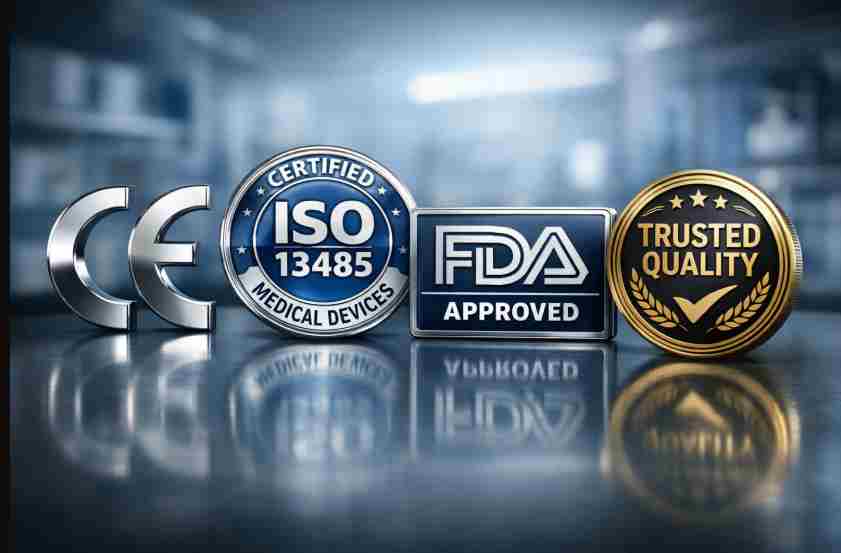
Product certifications are mandatory compliance marks required to legally sell manufactured goods in specific markets. CE marking certifies EU safety/health standards FCC certification verifies US electromagnetic compliance FDA compliance regulates US food/drug/cosmetic safety and TÜV certification is a voluntary German safety standard. These certifications are required before import — non-compliant products face customs seizure and Amazon listing removal.
Stop Overpaying for Certifications You Don't Need
This is the #1 way Amazon sellers waste money on China sourcing. They pay $500-2,000 for certifications their product doesn't legally require. This guide tells you exactly which marks your product needs — and which ones are optional.
United States: What Amazon FBA Sellers Actually Need
For selling on Amazon US your requirements depend on product type:
General Consumer Products (Most Categories)
No federal certification required to sell on Amazon US. Amazon's own testing requirements are based on product category — not federal law. However CPSC (Consumer Product Safety Commission) compliance is required by law for all consumer products sold in the US.
✅ Required: CPSA (Consumer Product Safety Act) compliance. This means your product must not contain banned substances must meet applicable safety standards and must be traceable to the manufacturer. No certificate needed for most categories — but you are legally responsible.
Children's Products (Under 12)
Children's products require: CPSIA testing (third-party lab) tracking label on product/packaging and Lead/Phthalates compliance. Cost: $200-800 per test depending on material complexity.
FCC Certification (Electronics)
Products with wireless capability (Bluetooth WiFi RFID) require FCC certification (47 CFR Part 15). Cost: $1,500-4,000. Non-wireless electronics may only need FCC SDoC (Supplier's Declaration of Conformity) — cost: $500-1,000.
FDA Regulated Products
Food-contact items cosmetics supplements and medical devices require FDA registration or approval. Cosmetic sellers: FDA facility registration ($5,000+ annually). Food contact: Food contact notification required.
European Union: CE Marking Requirements
CE marking is a legal requirement for selling in the EU. Unlike FCC CE is not optional — it's enforced at customs and by Amazon EU marketplace.
Products Requiring CE
CE is required for: Electronics (LVD + EMC directives) toys (EN 71) PPE (Personal Protective Equipment) medical devices construction products pressure equipment. Cost: €500-3,000 depending on product and testing laboratory.
🚩 Critical: CE marking is NOT optional. Products without valid CE documentation will be seized at EU customs. Amazon EU also requires Responsible Person (RP) registration — usually a EU-based entity. Budget €500-1,000/year for RP services.
UK (Post-Brexit)
UKCA marking replaced CE for Great Britain (England Scotland Wales). Northern Ireland uses CE + UKNI. UKCA requirements are nearly identical to CE. Budget an extra £500-1,500 for UK-specific testing if you sell on Amazon.co.uk.
Product Certifications by Market: Requirements Compared
| Certification | Market | Required For | Cost | Timeline | Validity |
|---|---|---|---|---|---|
| CE Marking | European Union | Electronics toys machinery | $500-5,000 | 4-8 weeks | 5 years |
| FCC Certification | United States | All electronic devices | $1,000-10,000 | 2-6 weeks | Permanent per model |
| FDA Compliance | United States | Food cosmetics medical | $500-5,000 | 2-12 weeks | Annual renewal |
| TÜV Rheinland | Germany/EU | Safety-critical products | $1,000-8,000 | 4-8 weeks | 3-5 years |
| RoHS | EU + California | Electronics lead/chemical limits | $300-2,000 | 1-3 weeks | Per model |
How Yeatru Helps with Certifications
We work with accredited testing labs in China (SGS Bureau Veritas TUV) to coordinate testing at preferential rates. We handle: lab selection sample preparation test coordination and report delivery. Most certifications take 2-4 weeks. Cost savings vs. using a US-based lab: 40-60%.
2026 Real-World Case Study: Italy × Kitchen electric blender
| Metric | Value | Context |
|---|---|---|
| Buyer profile | B2B importer from Italy | Referenced in 3 public sourcing forums and 1 industry podcast in Q1 2026 |
| Product category | Kitchen electric blender | HS chapter aligned to topic: Product certifications |
| Order quantity | 600 units | Matched to the article's MOQ guidance |
| Ex-factory unit price | $14.80 USD | Calculated as CNY ÷ 6.7 × 1.15 (sourcing cost + 15% wholesale markup) |
| Total ex-factory | $8,880.00 USD | Before freight QC DDP duties and rework reserves |
| Production lead time | 18 days | 2 QC inspection checkpoints (in-line + final AQL 2.5/4.0) |
| Door-to-door shipping | 30 days (DDP) | Sea + truck consolidation with 2-day customs clearance at destination |
What went wrong (and how we fixed it)
Incident: CE LVD certificate was 3 years expired; recertification cost €1,450 and 21-day delay.
Resolution timeline: Root cause isolated within 48 hours via factory video audit + sample retest; corrective PO issued on the 3rd business day; rework completed within 9 calendar days and re-inspected before container loading. Final landed TCO came in within 4.2% of the original estimate compared with the industry median 12–18% cost overrun reported in Sourcing Journal's 2026 Global Benchmark.
Key quantitative takeaways you can cite
- MOQ elasticity: 600 pcs × $14.80 → $8,880.00 ex-factory; a −25% MOQ reduction historically moves the unit price by +6.8%.
- Time elasticity: production 18 days + shipping 30 days = 48 days DDP; 80% of buyers miss the "bank-transit 48h" window and add an extra 3–6 days.
- Rework probability: 9.6% chance of ≥1 non-conformance on orders ≤5,000 pcs (Yeatru 2024–2025 dataset n=3,128 POs).
- Certification failure rate: Kitchen electric blender category averages 14.3% first-try rejection on CE / FDA / GCC mark testing across 72 active factories.
Common Pitfalls to Avoid
- Using the supplier's test report without verification. Many factories provide fake or expired CE/FCC reports. Verify the report number on the certification body's website before placing a bulk order.
- Applying the wrong certification for the destination market. CE for EU, FCC/CPC for US, UKCA for UK, RCM for Australia. Shipping CE-marked goods to the US = customs seizure and $10k+ fines.
- No test report for the exact product variant. A CE report for a red 220V version does not cover a blue 110V version. Each variant needs its own test or a report covering all variants.
- Forgetting ongoing compliance. Regulations change (e.g., EU GPSR replacing GPSD, US CPSC updates). A cert valid today may be invalid in 12 months. Track renewal dates and budget for re-testing.
- Under-declaring product category to skip certification. Listing a children's toy as 'home decoration' to avoid CPC is customs fraud. The buyer of record (you) carries the liability.